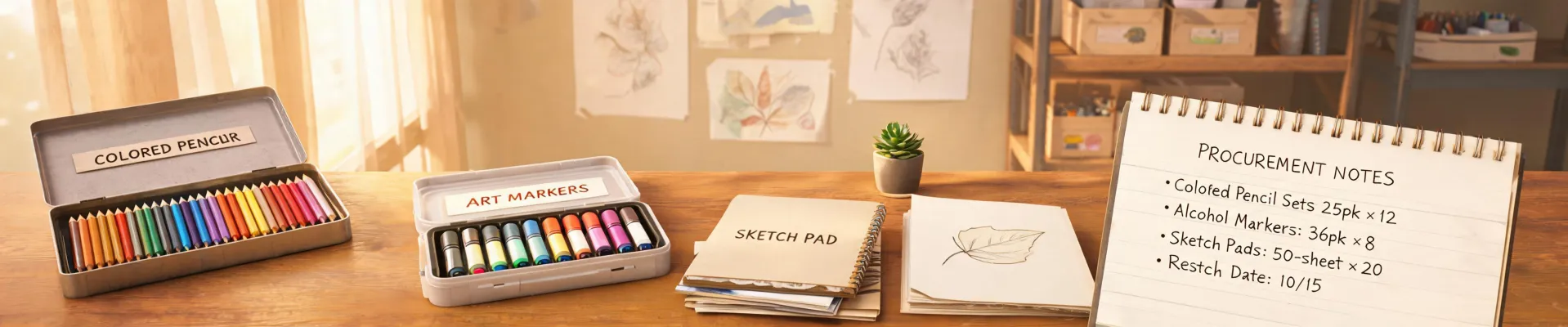
If you’re reading this, you might be the person in your organization tasked with restocking the art supplies. You’ve probably asked yourself: “Is the 24 pack of Prismacolor pencils enough for our team, or do we need the 48?” Or maybe you’ve looked at the 156-color Prismacolor marker set and thought, “That’s a lot of markers. Will our illustrators actually use them all?”
I get it. I’ve been there. My name is Mark, and I’ve been handling procurement for a mid-sized graphic design firm for about five years. In that time, I’ve made some costly mistakes with our Prismacolor orders. Mistakes that cost us time, money, and—honestly—a bit of professional credibility. I’m sharing this so you don’t have to repeat my errors.
The Surface Problem: “Which Pack Size Do We Buy?”
That’s the question that started it all. My team needed colored pencils for concept sketches and final illustrations. The obvious choice was Prismacolor—everyone on the team loved the soft-core feel and the pigment density. The debate was always about the 24 pack vs. the 48 pack vs. the 150 set.
We thought we were making a smart choice by buying multiple 24-pack boxes for different teams. It seemed more flexible. If one team ran out of a specific color, they could just grab another box. Simple, right?
I wish it were that simple.
The first sign of trouble came three months into our new system. We had ordered 10 boxes of the 24-pack Prismacolor Premier pencils for our design department. The cost per box was reasonable—about $25 each at the time, as of early 2024. Total investment: $250. Not a huge number, but significant for a mid-month budget allocation.
But here’s what we didn’t account for: color overlap. The 24-pack doesn’t have a single “standard” set. Different boxes had slightly different color assortments. You’d think “24 pack Prismacolor pencils” would be the same everywhere, but our vendor had mixed stock from different production runs. Some boxes had more blues, others more earth tones. When my team tried to share colors across projects, they ended up hunting through five open boxes to find a match. Productivity dropped. Frustration rose. One senior illustrator flat-out refused to use the “mismatched” supply.
That’s when I started digging into the deeper issue.
The Real Problem Isn’t the Pencil — It’s the Gap
Looking back, I should have asked: “What are we actually trying to accomplish?” We weren’t buying pencils to fill a storage bin. We were buying pencils to support a consistent, professional-grade workflow. But our buying process was treating the purchase as a commodity transaction.
We fell into the trap of thinking that any 24-box would do. That is a dangerous assumption.
The real issue came down to two things:
- Color consistency across orders. When you buy multiple 24-packs from different lots, you risk getting different color sets. For a design team that relies on exact shades for client presentations, that’s a big deal.
- The “just enough” mentality. We thought buying 24 colors was enough for everyone, but in practice, our illustrators needed a wider range for blending and gradients.
The customer’s core need wasn’t “I need a pencil.” It was “I need a predictable, high-quality color palette for professional output.” We failed to see that.
I’ve only worked with mid-range design firms and university art departments. I can’t speak to how this applies to luxury boutique markets or high-volume merchandise production. Your experience might differ. But for a standard office setting? This pattern repeated.
The Real Cost of Getting It Wrong
Let me put some numbers to this. After the initial $250 investment, we realized we needed to buy additional 48-pack sets to supplement the 24-packs. That added another $400. Then we had to buy a second set for a different studio, because the first batch was “contaminated” with the mismatched stock. Total spend: about $950. All to solve a problem that a single, deliberate purchase decision could have avoided.
But the cost wasn’t just financial. We lost time. I estimate we spent about 8 hours collectively across the team sorting and organizing the mismatched pencils. At an average hourly rate of $35, that’s $280 in lost productivity. Throw in the frustration points, the one illustrator who requested alternative materials, and the delay on two client presentations that needed specific color matching. The true cost was probably closer to $1,400 when you account for the rework and the morale hit.
The worst part? This all could have been prevented with a 10-minute conversation upfront.
“Missing the requirement for color variety and consistency resulted in a 3-day production delay on one project and an estimated $1,400 in combined costs.”
I didn’t see it coming. I was focused on the price per unit, not the total cost of ownership. I was thinking like a buyer, not like a user.
What I Do Now: The Simple Fix
After the third order with issues, I created what I call the “Prismacolor Pre-Check.” It’s a quick 3-step process. It’s not complicated. It just requires asking the right questions before you hit “purchase.”
- Confirm the color assortment. Ask the vendor if the 24-box has a specific color chart. If they can’t confirm, ask for a photo or a list. You want to know what you’re getting, especially if you’re buying multiple boxes.
- Match the user to the pack. For a single illustrator working on detailed portraits? The 48-pack or 72-pack is probably a better fit than the 24. For a classroom doing broad projects? The 24 might be fine. Don’t assume one size fits all.
- Buy for the project, not the catalog. Instead of stocking up on “general” supplies, order for specific upcoming projects. It ensures you’re buying the right colors and quantities. It also helps with budget tracking.
That checklist, which I started after my third mistake, has saved us an estimated $8,000 in potential rework over the last 18 months. Not bad for a 10-minute procedure.
Honestly, I’m not sure why this lesson isn’t taught in procurement training programs. My best guess is that everyone assumes art supplies are low-stakes items. They’re not. When you’re a design firm, the pencil is your hammer. If the hammer is inconsistent, the house wobbles.
I want to say this is foolproof, but don’t quote me on that. Every supply chain has quirks. If I could redo that first decision, I’d buy one 48-pack for the studio and two 24-packs for backup, and I’d confirm the color chart with the vendor first. But given what I knew then—nothing about the production run variability—my choice was reasonable. It was the best I could do with the information I had. The lesson? Sometimes you have to make the mistake to understand the system.
Now, I keep a shared document for Art Supply Requests, where the illustrators note what colors they actually use. It’s helped us cut waste and improve color consistency. The system isn’t perfect, but it’s better than managing 10 mis-matched boxes.
So, next time you’re ordering that 24 pack of Prismacolor pencils, take two minutes. Ask the question. Update the checklist. It’s the cheapest insurance you’ll ever buy.
Discuss a color supply plan
If this article relates to a classroom, reseller, or workshop program you are planning, send the context to Prismacolor and request product guidance.