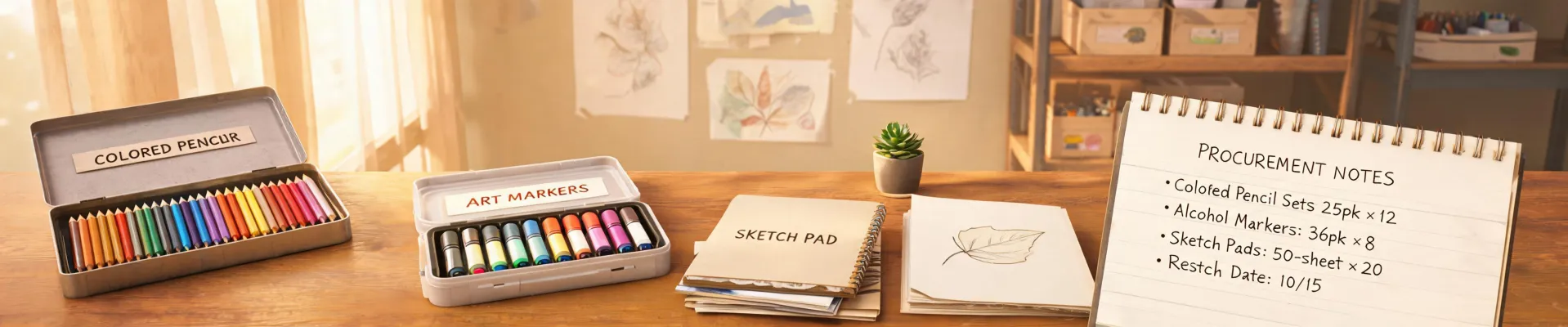
The Problem That Isn't What You Think
If you've ever had to order art supplies for a school or office, you know the drill: someone sends you a wish list that includes "Prismacolor pencils"—and then it's your job to figure out which set makes sense. The 12-pack? The 24? The full 150? And why does anyone need 150 pencils anyway?
That's the surface problem. The one everyone talks about. "How many colors do we actually need?"
But here's what I've learned after managing classroom supply orders for about 400 teachers across three locations: that question is completely backward. The real problem isn't about color count. It's about something I didn't even think about until my third year in this role.
The Deeper Problem Nobody Talks About
Let me back up. When I took over purchasing in 2020, I assumed art supply ordering was simple. Find the product, pick a quantity, repeat. I was wrong—or rather, I was only partly right.
The real challenge isn't picking the right Prismacolor set. It's making sure that set actually gets used. And that's where the 12-pack has a secret advantage that the bigger sets don't.
"Every cost analysis pointed to the 72-pack—better per-pencil price. Something felt off. Turns out, teachers were hoarding sets in locked cabinets to prevent theft. Students were sharing, which meant nobody had the colors they needed."
Never expected the smaller pack to outperform the big one. The surprise wasn't the price per pencil—it was the friction. With the 12-pack, each student gets their own set. They're not fighting over the same 24 greens. They're not hoarding colors because they're afraid the good pencils will disappear. The 12-pack creates a system where the pencils are available, accessible, and actually used.
Now, I'm not a classroom behavior specialist—that's way outside my lane. What I can tell you from a procurement perspective is that supply effectiveness drops dramatically when you create shared resources. I've seen it across every department, not just art.
What the Numbers Don't Tell You
I remember one school where we ordered the 150-pack for the art room. It looked great on paper—$250 for the set, about $1.67 per pencil. Compare that to the 12-pack at $12—that's about $1 per pencil. Bulk seems smarter, right?
Except the art teacher reported that within two months, roughly 40% of those pencils were lost or broken. Students weren't responsible for the materials—they were "community supplies." The 12-pack, assigned individually, had a dramatically lower loss rate. Maybe 5-10%. Actually, I'm ballparking—I'd have to pull the inventory reports. But the pattern was clear.
The Cost of Getting This Wrong
So what's the actual risk of picking the wrong Prismacolor set? Not just wasted budget—though that matters when you're managing $15K a year in art supplies alone.
Here's the part that made me look bad once: when the VP of operations asked why we needed a third reorder of supplies before the semester ended. The school had the budget, but the optics were terrible. "How can you need more pencils—we just bought 150 of them?" The answer was that we'd bought the wrong distribution model, not the wrong pencil.
If I could redo that decision, I'd have piloted the 12-pack approach first. But given what I knew then—that bigger sets seem like better value—I was following standard procurement logic. It wasn't wrong. It just wasn't right for the actual use case.
The Solution That Feels Too Simple
Here's where I get to the recommendation, and I'll keep it short because the problem analysis is where the real work happened.
For K-12 schools, standardized testing prep rooms, corporate training centers, and any environment where multiple people need equal access to art supplies: start with the Prismacolor 12-pack. It's the right balance of quality, cost, and usability.
- Per-pencil cost: About $1.00-1.20 when bought in bulk cases of 12-packs (based on recent pricing from major educational suppliers; verify current rates).
- Color range: The classic 12 includes red, blue, green, yellow, orange, purple, brown, black, white, and a few earth tones. Enough for most classroom projects—not enough for professional illustration, but that's a different use case.
- Durability: The soft core means they blend beautifully—but also break more easily than harder pencils. The 12-pack keeps replacement costs low enough that this isn't a deal-breaker.
The vendor who told me "the 12-pack is better for classrooms" earned my trust for everything else. They could have upsold me to the bigger set. They didn't. That matters when you're managing 8 vendors across different needs and don't have time to second-guess every recommendation.
Trust me on this one: start with the 12-pack. If the teacher or department head pushes back, get them to articulate exactly which additional colors they need—and add those as singles. You'll save money, reduce waste, and avoid the "where did all the good colors go" problem entirely.
Oh, and one more thing: the blending quality is the same whether you buy the 12-pack or the 150. So don't let anyone tell you you're buying "lesser" pencils. You're buying the right ones.
Discuss a color supply plan
If this article relates to a classroom, reseller, or workshop program you are planning, send the context to Prismacolor and request product guidance.