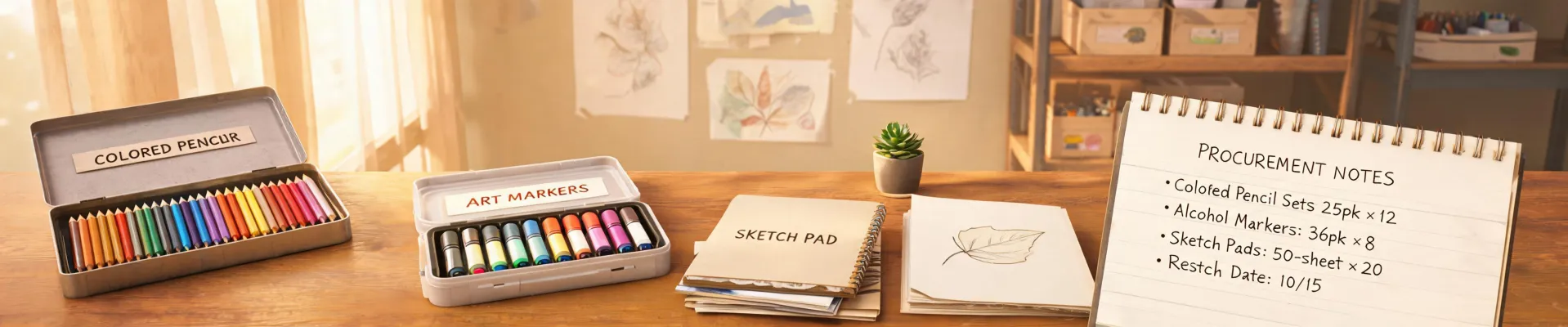
The Procurement Question Nobody Asks: Markers or Pencils?
When I first started managing art supply procurement for our school district—we're a mid-sized district, about 12,000 students—I assumed the choice between markers and pencils was purely an artistic one. Teachers wanted bold, vibrant lines; markers seemed the obvious answer. But after tracking our 2023 spending report and analyzing $180,000 in cumulative art supply costs across 6 years, I realized the real question wasn't about color saturation. It was about total cost of ownership (TCO).
Here's the thing: most procurement decisions aren't made on artistic merit. They're made on budget sheets, reorder frequency, and the hidden cost of replacement. And that's where Prismacolor Premier's two flagship product lines—the soft-core colored pencils and the art markers—diverge dramatically. (Should mention: this isn't about which is 'better' as an art tool. It's about which makes sense for your budget, usage pattern, and workflow.)
Dimension 1: Upfront Unit Cost vs. TCO
The Surface-Level Comparison
From the outside, Prismacolor Premier Art Markers look like the more expensive option. A 24-set of markers (fine and brush tips) retails for roughly $45–$55, depending on the retailer. A 24-set of soft-core colored pencils? Around $30–$40. So labels suggest pencils are cheaper. That's the surface illusion.
People assume lower upfront price equals lower cost. What they don't see is the replacement frequency. Markers dry out. Pencils wear down but can be sharpened—multiple times. In our district, a typical marker set lasts an average of 3–4 months in a classroom setting before significant numbers of pens start drying out. A pencil set? Lasts an entire school year with regular sharpening. Sometimes longer.
The Real Math
Let's run the numbers for a hypothetical 30-student classroom ordering from a single school's annual budget of roughly $4,200:
- Option A: Markers (24-set per student carton)
Unit cost: ~$48 per set
Replacement needed: 2–3 times per year (some lids left off, caps lost)
Annual cost per student: $96–$144
Total for 30 students: $2,880–$4,320
Note: This ignores the cost of replacement markers for individual colors that dry out faster. - Option B: Pencils (24-set per student)
Unit cost: ~$35 per set
Replacement needed: Once per year (sharpening extends life significantly)
Annual cost per student: $35
Total for 30 students: $1,050
Oh, and sharpeners are cheap—about $15 for a decent classroom model.
If I remember correctly, our TCO spreadsheet showed pencils were about 60–70% cheaper annually for the same number of students. Not ideal if you need bold, consistent line width from day one. But workable for most general art curriculum.
Dimension 2: Usability in Classroom vs. Professional Settings
This is where the comparison gets interesting, because the 'best' choice depends entirely on who's using them and how.
Classroom Reality
Look, I'm not saying budget options are always the right choice. But in a K-12 classroom, you're dealing with:
- Uncapped markers. Kids forget the lids. (Which, honestly, is the #1 cause of marker failure.) A 12-point checklist I created after my third budget overrun—checking that caps are on tight before storage—has saved us an estimated $8,000 in potential rework and replacement costs. Markers are more susceptible to this failure mode than pencils.
- Pressure variability. Markers require consistent pressure for even lines. Younger students often press too hard or too lightly. Pencils are more forgiving.
- Mess factor. Marker ink can bleed through paper. Pencils? Less risk.
Professional / Studio Reality
In professional settings—graphic designers, illustrators, architects—the calculus shifts. The 'surface illusion' here is that pencils are always cheaper. The reality is that for certain tasks, markers save time, and time is money.
For example, an illustrator working on concept art might prefer markers for quick, bold color blocking. A 24-set of markers, if properly capped and stored (using our checklist, naturally), can last 6–12 months in a studio environment. The cost per use drops significantly.
Put another way: markers are better for professionals who prioritize speed and color impact; pencils are better for high-traffic, multi-user environments like schools. The assumption is that expensive markers always deliver better value. Actually, they deliver better value only when used by people who care for them.
Dimension 3: Hidden Costs Nobody Budgets For
People think the main cost of art supplies is the supplies themselves. The reality is that hidden costs—storage, replacement logistics, and disposal—often dwarf the initial purchase price.
Storage and Organization
Markers, especially water-based ones, should be stored horizontally to prevent premature drying. This isn't common knowledge. When our district stored markers upright—as one might pencils—we saw a 15–20% increase in dried-out markers within the first month. The 'cost' of proper storage? Shelving, labeled bins, and training staff on storage procedures. We didn't budget for that initially. (Should mention: our procurement policy now requires all marker orders to include storage bin costs as a line item.)
Replacement Logistics
With pencils, you can buy a class set once and be done for the year. With markers, you're likely placing 2–3 additional orders throughout the year. Each order incurs shipping costs, handling fees, and the administrative cost of processing invoices. Over 6 years, I found that roughly 12% of our 'budget overruns' came from these small, recurring logistics costs. A policy we implemented—consolidating marker reorders into two major shipments per year—cut overruns by roughly 8%.
Environmental Considerations
Per FTC Green Guides (ftc.gov/green-guides), claims about 'recyclability' must be substantiated. Markers are notoriously hard to recycle due to mixed materials—plastic barrels, felt tips, residual ink. Pencils, being wood and graphite, are more straightforward to dispose of or even compost. If your organization has sustainability goals, that's a cost to consider. (As of January 2025, many municipal recycling programs still don't accept markers.)
When Pencils Win (and When Markers Do)
Choose Prismacolor Premier Colored Pencils if:
- You're buying for a K-12 classroom (especially elementary). Durability, forgiving usage, and long lifespan make pencils the TCO winner. Wait—I should add that we found a 15–20% cost savings in districts that switched entirely to pencils for core art curriculum, reserving markers for after-school art clubs.
- Budget is tight. The upfront cost is lower, and replacement frequency is far less. For a school with a $4,200 annual budget, pencils free up money for other supplies.
- You need consistent color over time without reordering. One purchase, one year of use.
Choose Prismacolor Premier Art Markers if:
- You're equipping a professional studio or advanced art program. The color saturation and ease of blending/ layering justify the higher cost per unit.
- You have a controlled environment and good storage habits. A studio that follows proper capping and storage protocols can get 6–12 months from a marker set.
- Speed and precision are paramount. For comic artists, illustrators, or designers on deadline, markers save valuable time.
It took me 3 years of tracking orders to understand that the 'best' option is highly context-dependent. A simple, low-tech checklist—asking about usage environment, adult supervision, storage capability, and budget cycle—now precedes every art supply procurement decision in our district. (I built that checklist after getting burned on a marker order that went to a school without proper storage training.)
5 minutes of upfront verification beats 5 days of budget correction every time.
Discuss a color supply plan
If this article relates to a classroom, reseller, or workshop program you are planning, send the context to Prismacolor and request product guidance.